Buses are a good choice for getting to those areas of Kyoto that are not easily accessible by train or subway. There is also a Subway & Bus 1-Day Pass that can make transport economical if you plan to combine buses and subway rides in one day.
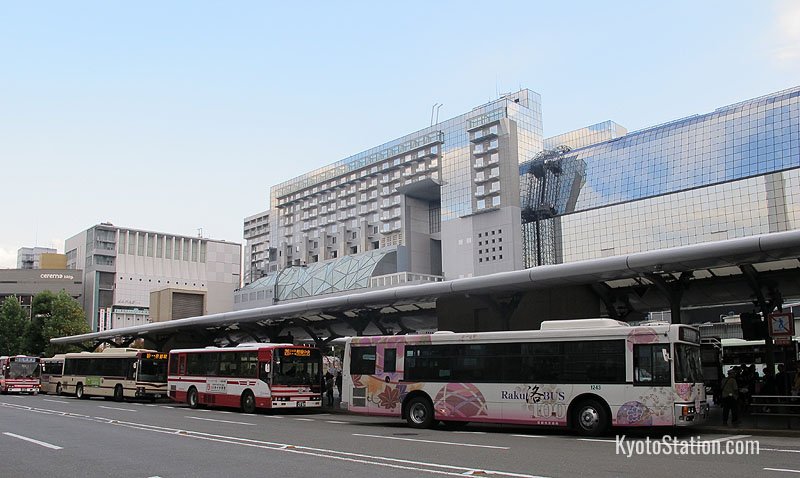
Buses at Kyoto Station
Boarding and Payment
- In Kyoto, ordinary buses are boarded from the rear and exited from the front. Sightseeing Limited Express Bus EX100 and EX101 are different: you board from the front, pay when boarding, and exit from the rear.
- On ordinary buses, payment is made at the front, into a machine by the driver’s seat, when you get off.
- You should pay with the exact fare. If you don’t have the exact fare, there is a change machine beneath the payment slot that can break down coins and 1000 yen notes.
- Within the city there is a flat fare zone, where adults only have to pay 230 yen and children under 12 years old pay 120 yen. Sightseeing Limited Express Bus EX100 and EX101 have a separate fare of 500 yen for adults and 250 yen for children, unless you are using a valid Subway & Bus 1-Day Pass.
- Outside of the flat fare zone, you will have to pay extra. Take a numbered ticket when you enter the bus and the screen at the front of the bus will show your number and fare.
- Rechargeable IC cards such as Suica, ICOCA, PASMO and PiTaPa can be used on Kyoto City Bus and Kyoto Bus services. Outside the flat fare zone you should touch your card to an IC card reader when you enter the bus and again on your way out.
- Kyoto City has a detailed explanation of how to use buses in Kyoto with diagrams and pictures in the official Kyoto City Bus & Subway Information Guide.
Bus types
There are various bus companies operating in Kyoto but the two main ones are Kyoto City Bus and Kyoto Bus. In general Kyoto City Bus operates within the central city area, and Kyoto Bus serves the more outlying areas.
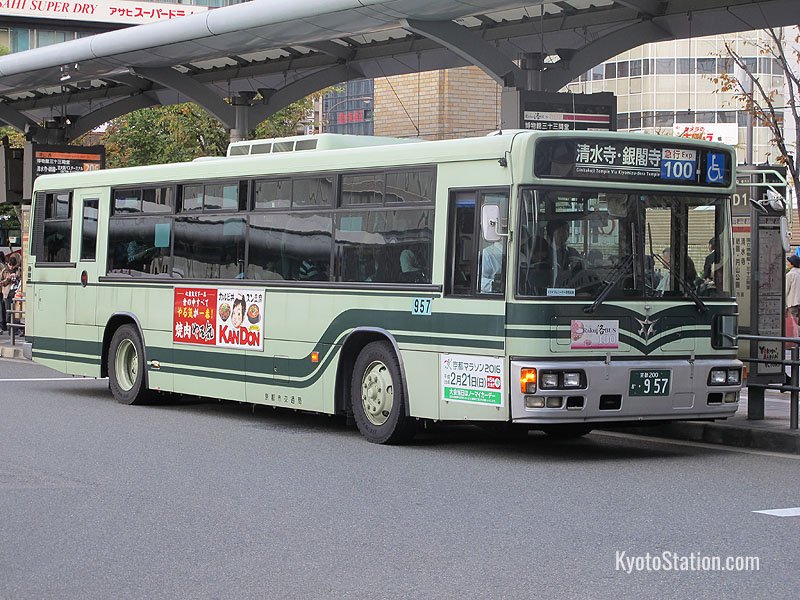
A Kyoto City Bus
Kyoto City buses are uniformly green and easily recognized.
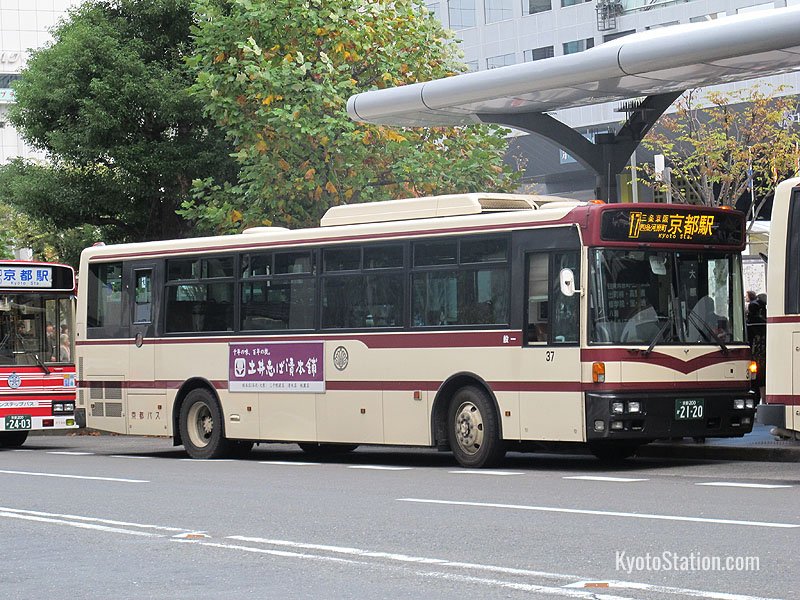
A Kyoto Bus
Kyoto buses are cream colored with red trimming. Kyoto Bus services departing from Kyoto Station serve areas such as Arashiyama and Sagano, Ohara and Mount Hiei. Many of these buses go outside the city’s flat fare zone.
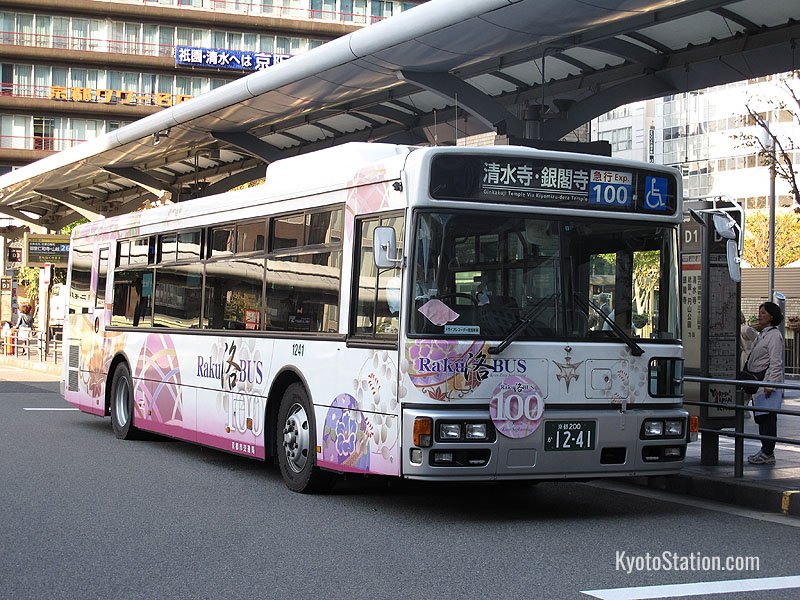
A sightseeing bus in Kyoto
There is also a Sightseeing Limited Express Bus service for some of the busiest tourist routes from Kyoto Station. These buses are aimed at visitors heading toward Kiyomizudera Temple, Gion, Heian-jingu Shrine and Ginkakuji Temple. They stop at fewer stops than ordinary buses, but they use a different boarding system and a different fare.
Sightseeing Limited Express Bus EX100
Sightseeing Limited Express Bus EX100 links Kyoto Station with Gojozaka for Kiyomizudera Temple, Gion, Okazaki Koen Bijutsukan / Heian Jingu-mae, and Ginkakuji-mae. From Kyoto Station, travel times are about 10 minutes to Gojozaka, 17 minutes to Gion and 30 minutes to Ginkakuji Temple.
Sightseeing Limited Express Bus EX101
Sightseeing Limited Express Bus EX101 links Kyoto Station with Gojozaka for Kiyomizudera Temple. Both EX100 and EX101 cost 500 yen for adults and 250 yen for children, or no extra charge with a valid Subway & Bus 1-Day Pass. Check the official guide or route planner before setting out, because operating days and times can change.
Popular Hotels near Kyoto Station

Discount Passes
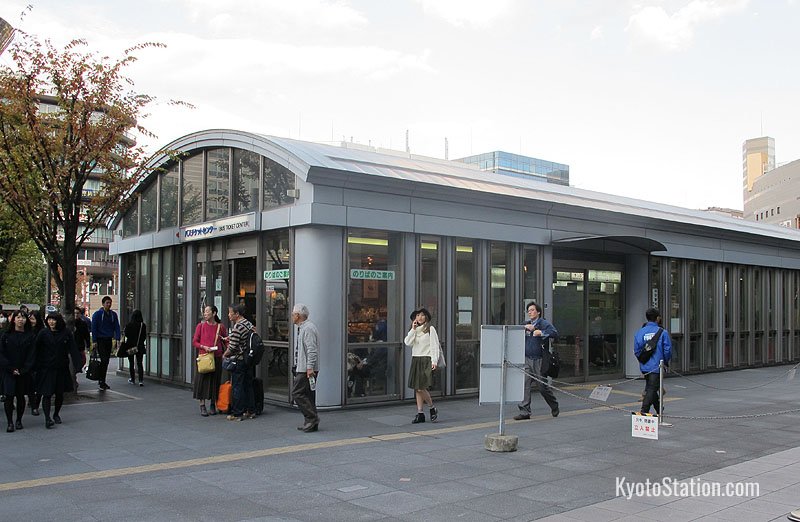
Get your discount passes at the Kyoto Bus Information Center
There are a number of discount passes available that can reduce your transportation costs. You can buy the Subway & Bus 1-Day Pass at Kyoto City Bus & Subway Information Centers, including the Kyoto Station office, and at other listed sales locations.
The Subway & Bus 1-Day Pass is 1,100 yen for adults and 550 yen for children. It covers all Kyoto Municipal Subway lines, all Kyoto City Bus routes, and Kyoto Bus, Keihan Bus and West Japan JR Bus routes within the designated areas. It can also be used on the Sightseeing Limited Express Bus. This is the main Kyoto City pass to consider if you plan to combine buses and subway rides in one day.
The bus-only day pass is no longer sold. For ordinary pay-as-you-go travel, use cash or rechargeable IC cards such as ICOCA, Suica, PASMO and PiTaPa.
The KANSAI RAILWAY PASS is a separate private railway and metro pass for wider Kansai travel and should not be treated as a Kyoto bus pass. Check the official Surutto Kansai site before buying it for a wider Kansai itinerary.
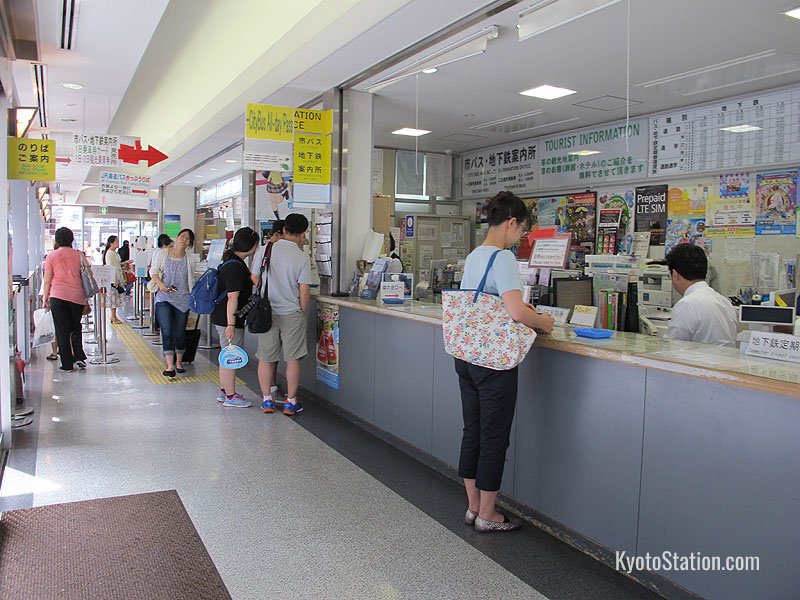
Inside the Kyoto Bus Information Center
Recommended Destinations
If you are only in Kyoto for one day, the Subway & Bus 1-Day Pass can be useful if you combine subway hops with buses rather than doing the whole circuit by road. For a busy route through northern Kyoto and Higashiyama, check the route planner before setting out. To travel between Kinkakuji and Ginkakuji, Kyoto City Bus 204 remains a useful cross-town option. For Kyoto Station, Kiyomizudera Temple, Gion, Heian-jingu Shrine and Ginkakuji Temple, the Sightseeing Limited Express Bus can also be useful on its operating days. Use the official Kyoto City Bus & Subway Information Guide or the current route maps to plan your routes.
North West Kyoto
Take Kyoto City Bus 205 from Kyoto Station and get off at the Kinkakuji-mae bus stop. From here Kinkakuji Temple, Ryoanji Temple, and the Myoshinji Temple complex are all within striking distance.
North East Kyoto
Take Kyoto City Bus 5 or 17 from Kyoto Station for Ginkakuji-michi bus stop. From here you can visit Ginkakuji Temple, followed by a stroll along the Philosopher’s Walk to Honenin Temple. If you like walking you can continue south from here for another 20 minutes to Eikando Temple and Nanzenji Temple. Be sure to take Kyoto City Bus 5 from Kyoto Station, and not Kyoto City Bus 南5 as the character 南 means “south” and so it goes in completely the opposite direction!
Ohara
Ohara is a scenic rural village to the north of Kyoto which is only accessible by car or bus. Despite its isolation, it has many temples of historical importance and the temple of Sanzenin is particularly famous for the beauty of its gardens. Take Kyoto Bus 17 or Special 17 from Kyoto Station and get off at Ohara. The trip will take about 1 hour.
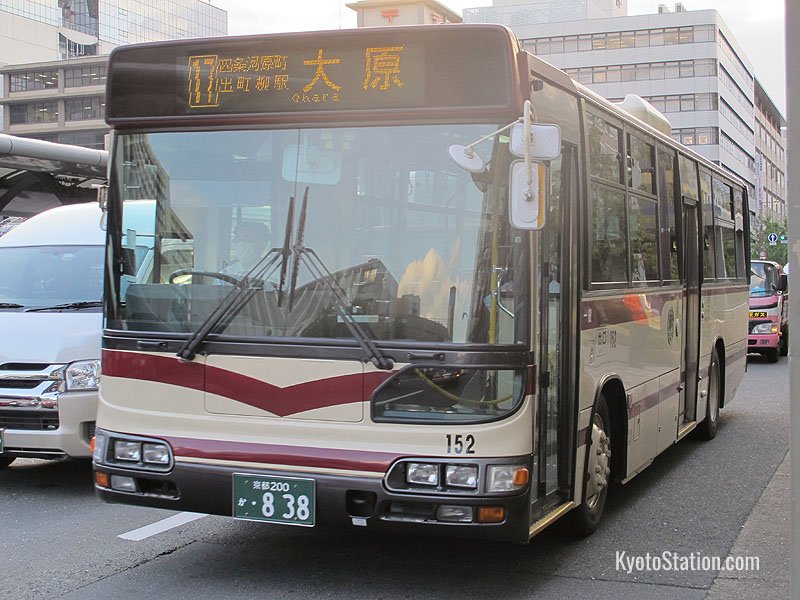
Kyoto Bus 17 bound for Ohara
For other sightseeing locations, use the official Kyoto City Bus & Subway Information Guide and the current Kyoto City Transportation Bureau route maps. These provide sightseeing tips, information on how to board and pay your fare, and route maps for key locations. The flat fare zone is marked on the map.
Alternatives
Buses are a relatively cheap way to get around, but they can be time consuming, especially if traffic is heavy. If you are in a group of two or more people, you might find it worth your while sharing the cost of a taxi. Alternatively, if you are in good health, you might want to consider renting a bicycle instead.
Article and original photos by Michael Lambe. All rights reserved. Last updated 20-Jun-2026.